★ Offline search-to-language distillation

Self-Play Search Distillation
for Large Language Model Reasoning

Strong search experts play board games against themselves. SPSD harvests their verifiable decisions and search traces offline, then distils them into reasoning supervision for a separate language-model student — decoupling data quality from the learner.

Lorenzo Molfetta1 Wai-Chung Kwan2 Giacomo Frisoni1 Luca Ragazzi1 Gianluca Moro1 Pasquale Minervini2,3
1University of Bologna  ·  2University of Edinburgh  ·  3Miniml.AI
The core idea

Keep the teacher outside the learner

Reasoning post-training is bottlenecked by human-annotated data: it is scarce, expensive, and anchors the model to human-level intermediate decisions. Letting a model generate its own signal helps with scale, but when the same model family is both teacher and student, the data inherits the learner's own errors. SPSD breaks this entanglement.

♟

Executable games as a controlled lab

Board games expose exact states, legal actions, and terminal outcomes. Difficulty is tunable through rules, openings and board sizes, and they support strong search experts whose quality improves independently of the LLM.

🔭

Search experts, frozen & external

ExIt-family teachers (MuZero / EfficientZero MCTS) are trained by self-play, then frozen. They generate verifiable decisions and auditable search traces — never sharing parameters with the student.

📜

Search → language supervision

Each expert decision is rendered into a grounded conversation. SPSD-CoT linearizes rejected alternatives, opponent replies and replayed terminal evidence into a compact, replayable reasoning trace.

5
source game families
50
trainable environments (5 + 9 variants each)
15
held-out games for cross-family transfer
8
external reasoning benchmarks

Why it matters

Online self-play vs. offline distillation

Most self-play reasoning pipelines (e.g. SPIRAL) keep the learner inside the loop: the same policy generates trajectories and is optimized on them, tangling curriculum, opponent, trace quality and student into one objective. SPSD separates the search source from the student.

● Learner-coupled self-play

Data quality is entangled with the current student policy.

🤖 LLM policy plays the game
↻ Same LLM is optimized on its own traces
⚠ Errors & biases recycle through the loop

● SPSD — decoupled teacher

A frozen search expert is a pure offline data generator.

🔭 Search expert plans in the simulator
📦 Verifiable decisions + traces exported offline
🎓 Separate LLM student learns from rendered text

The framework

From simulator-grounded search to text

The student never acts in the simulator during post-training — it learns only from rendered conversations grounded in verified game states. The pipeline has four stages.

STAGE 01

Executable interface

Each game defines a state space, legal-action function, transition function, terminal predicate and an outcome in [-1, 1], plus a renderer that turns a state into a prompt.

→
STAGE 02

Frozen ExIt teacher

Train or select a MuZero / EfficientZero MCTS expert by self-play, then freeze its checkpoint for data generation.

→
STAGE 03

Export search record

For every move, export one compact record: selected action, root visit distribution, value estimate, ranked candidates and replayable branch prefixes.

→
STAGE 04

Render supervision

Turn each record into either SPSD final-action supervision or SPSD-CoT procedure-cloning traces — same prompt, different response.
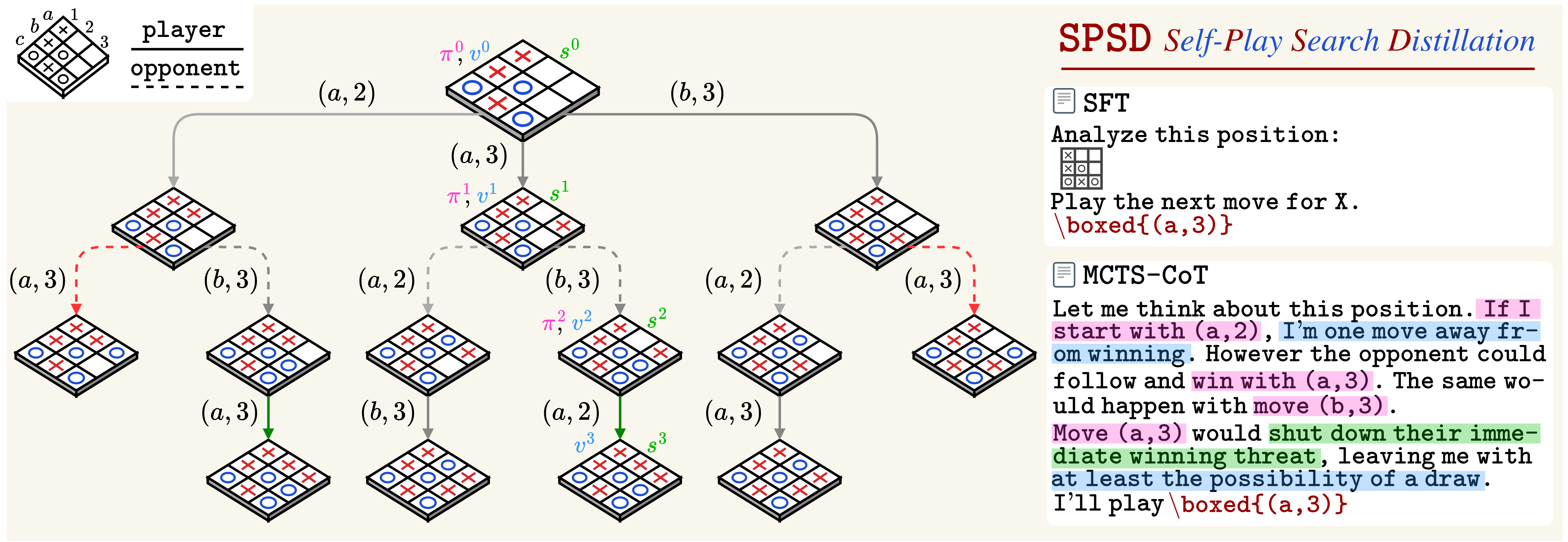
SPSD self-play search data-generation pipeline: self-play experts generate direct SPSD state-action examples and SPSD-CoT procedure-cloning traces from the same executable game state.

The self-play search data-generation pipeline. Self-play experts generate direct SPSD state–action examples and SPSD-CoT procedure-cloning traces from the same executable game state. Raw visits, priors and Q-values select which branches are retained, but are never exposed in the surface text.


The corpus

Five games, five reasoning primitives

Parent games were drawn from the Ludii repository, ported into a maintained executable interface, and kept only after deterministic checks of legal actions, transitions, terminal outcomes and rendering. Each parent stresses a distinct reasoning skill; nine validated variants per parent perturb the rules while preserving board shape and action space.

Connect4

Alignment planning under gravity

Pieces fall to the lowest empty slot, so a move is never local: the player must plan vertical, horizontal and diagonal alignments while reasoning about what each drop enables for the opponent. Delayed consequences emerge several moves later, making it a clean test of forward state tracking.

Tic-Tac-Chess

Rule-conditioned tactics

A compact grid where chess-like movement rules meet a tic-tac-toe-style objective. Legality depends on piece type and position, so the model must condition its tactics on shifting rule constraints rather than memorizing fixed patterns.

3 6 9

Counting over scored lines

Outcomes hinge on counting and thresholds across scored lines. The reasoning primitive is arithmetic accumulation under changing board state — exactly the kind of structured counting where LLMs tend to slip.

Domineering

Spatial tiling and blocking

Players place dominoes in opposing orientations; victory comes from tiling your own space while blocking the opponent's. It rewards spatial reasoning, parity arguments and territory control over many turns.

First Attack

Constraint satisfaction over attack lines

Winning requires satisfying constraints across multiple attack lines simultaneously. The model must juggle interacting conditions — a discrete constraint-satisfaction problem disguised as a board game.

For cross-family transfer, 15 additional games are reserved as a held-out set and are never used for SPSD data generation. This separates two kinds of generalization: transfer across nearby variants of a known family, and transfer to entirely unseen families.


Two supervision formats

SPSD vs. SPSD-CoT

Both formats share the same prompt and the same boxed-action contract, and end on the same expert-selected move. They differ only in the assistant response — so any difference in transfer isolates the value of the search procedure, not answer formatting.

spsd_supervision.txt


SPSD-CoT verbalizes only a small number of rejected alternatives, searched opponent replies and replay-derived terminal evidence — every verbalized branch is replayable as a legal simulator prefix. It is a compressed procedure-cloning target, narrower than ASTRO-style linearization: it starts from the expert's chosen action and explains why it was selected.


The study

Five research questions

The main study trains Qwen3-4B by supervised fine-tuning on rendered game conversations, and compares against base Qwen3 and SPIRAL, the closest online LLM self-play baseline.

RQ1 Does SPSD transfer reasoning capabilities? ▾
Measures transfer to an external reasoning suite (MATH500, AIME24/25, AMC23, OlympiadBench, MinervaMath, GPQA, MMLU-Pro). Establishes the base and SPIRAL baselines against which the SPSD students are compared.
RQ2 Does SPSD generalize beyond memorization? ▾
Sweeps the source pool over 5 → 10 → 20 → 30 → 40 → 50 environments to test whether transfer grows with game coverage, measured on external reasoning and on win-rate over the 15 held-out games.
RQ3 Does SPSD-CoT improve reasoning beyond final-action imitation? ▾
Isolates the supervision format at matched game count: do searched alternatives and replayed outcomes add measurable transfer over cloning only the expert's final action?
RQ4 How does MCTS depth affect transfer? ▾
Varies the teacher search budget (32 / 64 / 128 / 256 simulations per move) while holding the student, renderer and source pool fixed — testing how much stronger search translates into better supervision.
RQ5 Do trained traces become more MCTS-shaped? ▾
A search-geometry analysis maps each model trace to a search-tree schema and measures breadth (β, legal root-action coverage), focus (γ, root-subtree Gini concentration), depth (δ, chosen-subtree depth) and win rate (ω) — comparing SPSD-CoT against SPIRAL-style self-play across model families.

RQ1 · external reasoning

Reasoning-benchmark baselines

Average and per-benchmark accuracy on the external reasoning suite. SPSD and SPSD-CoT rows are reserved as planned comparison conditions and will be filled in upon final evaluation.

Student · ConditionAvg.MATH500AIME24AIME25AMC23OlympiadMinervaGPQAMMLU-Pro
Qwen3-4B · Base34.073.49.66.242.433.329.430.647.2
Qwen3-4B · SPIRAL-SFT39.774.213.711.751.137.640.137.851.3
Qwen3-4B · SPIRAL-RL44.578.219.713.361.641.842.640.158.5
Qwen3-4B · SPSD ourssoon————————
Qwen3-4B · SPSD-CoT ourssoon————————
Qwen3-8B · Base39.577.012.111.250.633.538.238.055.7
Qwen3-8B · SPIRAL-SFT46.182.819.915.663.545.940.841.658.8
Qwen3-8B · SPIRAL-RL49.686.626.216.865.249.646.344.661.1

⚠️ This is a preprint in progress: SPSD / SPSD-CoT measurements are pending and shown as “soon”. The accompanying figures show that even large LLMs remain brittle on held-out board-game play, motivating board games as a compact stress test for state tracking and branch comparison. Fine-tuning runs use 4×H200; EfficientZero teachers train on 1×A100; game benchmarking uses 2×A100.


Citation

Cite this work

This paper is not yet on arXiv. Please cite the preprint and check back for the arXiv version.

spsd.bib
@misc{molfetta2026spsd,
  title  = {Self-Play Search Distillation for Large Language Model Reasoning},
  author = {Molfetta, Lorenzo and Kwan, Wai-Chung and Frisoni, Giacomo
            and Ragazzi, Luca and Moro, Gianluca and Minervini, Pasquale},
  year   = {2026},
  note   = {Preprint},
  url    = {https://edinburghnlp.github.io/spsd/}
}